Some achievements in space are measured in kilometres, others in milliseconds. For RF Microtech, the success of ESA’s first Celeste mission can be measured in something even more fundamental: a signal.
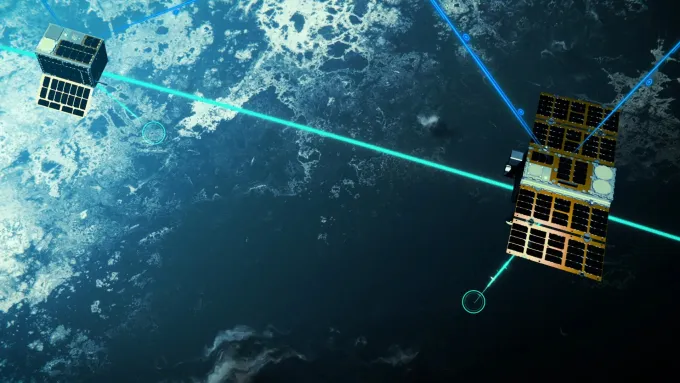
Today, Celeste is demonstrating a new generation of Positioning, Navigation and Timing (PNT) services from Low Earth Orbit, opening the way for a future where navigation systems are more resilient, more robust and closer to users on Earth. Behind every transmitted signal, however, lies years of engineering, testing and technological development performed by a network of European companies and institutions working toward a common goal.
RF Microtech is proud to be part of that journey.
The Story Behind the Name

The mission’s name, Celeste, pays tribute to Maria Celeste, daughter of Galileo Galilei. More than a historical reference, the name reflects a spirit of scientific curiosity and innovation that continues to drive European space exploration today.
Just as Galileo transformed our understanding of the heavens centuries ago, Celeste is helping Europe explore new possibilities for satellite navigation by bringing navigation services closer to Earth through Low Earth Orbit constellations
Rethinking Satellite Navigation
For decades, global navigation systems have relied on satellites operating thousands of kilometres above Earth.
Celeste explores a complementary approach.
Operating in Low Earth Orbit, the mission is designed to demonstrate how future navigation services can benefit from stronger signals, enhanced robustness and improved performance in challenging environments. The programme represents an important step toward a multi-layered European navigation architecture capable of complementing existing GNSS infrastructures and supporting the next generation of applications.
As Europe investigates the future of satellite navigation, Celeste’s first crucial in-orbit demonstrator, transforming concepts and technologies into operational reality.
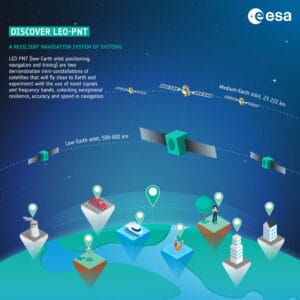
Unlike traditional GNSS constellations operating at altitudes of around 20,000 km, LEO-PNT satellites orbit much closer to Earth, typically between 500 km and 1,500 km. This proximity enables significantly stronger signals, lower latency and enhanced positioning performance, particularly in environments where conventional navigation systems often struggle.
The benefits are substantial:
- Stronger signals: The reduced distance between satellites and users results in signals that can be orders of magnitude stronger than those received from traditional GNSS constellations. This improves signal availability in dense urban environments, so-called “urban canyons”, and can enhance reception in partially obstructed areas.
- Faster convergence and higher accuracy: LEO-PNT architectures can support rapid high-precision positioning solutions, making them particularly attractive for autonomous mobility, maritime navigation and other applications requiring near real-time centimetre-level accuracy.
- Greater resilience through diversification: Rather than replacing existing navigation systems such as Galileo, LEO-PNT is designed to complement them. By introducing an additional layer of navigation infrastructure, future services can benefit from increased robustness, reduced single-point vulnerabilities and improved continuity for critical sectors including transportation, precision agriculture, energy distribution and telecommunications.
ESA’s Celeste mission is one of Europe’s key initiatives for validating these concepts in orbit and assessing their potential for future operational services.
RF Microtech’s Contribution
Space missions depend on thousands of components working flawlessly together.
Among them are the radio-frequency technologies responsible for ensuring that signals maintain their integrity throughout the transmission chain.

For the ESA Celeste mission, RF Microtech provided space-qualified RF filters designed to meet the demanding requirements of the navigation payloads. Developed and manufactured according to the highest standards of the space industry, these filters help preserve signal quality and ensuring reliable operation in the harsh environment of space.
While these technologies remain invisible once a satellite reaches orbit, their performance becomes evident every time a signal is successfully transmitted and received.
The operational success of Celeste and the reception of its navigation signals confirm the effectiveness of the technologies working behind the scenes including the RF solutions that help make the mission possible.
Custom RF Filters Designed for Celeste
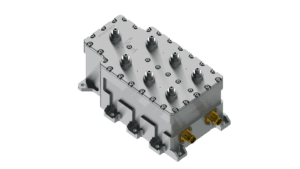
Among the technologies enabling Celeste’s navigation experiments are three custom RF filters developed by RF Microtech and integrated onboard IOD-2, the 16U CubeSat designed by Thales Alenia Space for ESA’s Celeste programme. Consisting of two L-band filters and one S-band filter, these space-qualified components have been specifically engineered to support the mission’s challenging radio-frequency environment, helping ensure the quality, integrity and reliability of the navigation signals transmitted from orbit.
Their role is essential. The filters selectively manage the radio-frequency signals processed by the payload, suppressing unwanted interference while preserving the integrity of the navigation signals by the satellite. By ensuring high signal selectivity and quality, they contribute directly to the reliability and performance of the onboard RF chain.
 L-band filter
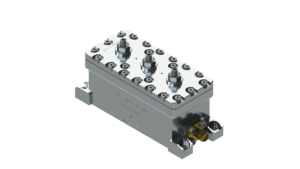 S-band filter
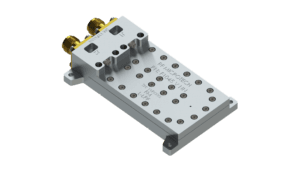 L-band filter
Discover more about our space filters.
For RF Microtech, Celeste represents more than participation in a pioneering European mission. It is another demonstration of our ability to develop and deliver highly specialized RF technologies for advanced space applications, capable of performing in the most demanding operational environments, where maintenance is impossible and every component must function exactly as intended. By supporting European programmes such as Celeste, we contribute to shaping the future of satellite navigation.
Why LEO-PNT Matters and Why Filtering Technologies Are Essential
Celeste is part of a new generation of Low Earth Orbit Positioning, Navigation and Timing (LEO-PNT) systems that are redefining the future of satellite navigation.
The Critical Role of RF Filters
As navigation systems become more sophisticated, ensuring signal integrity becomes increasingly important.
Although stronger than traditional GNSS signals, LEO-PNT transmissions must still operate within a complex radio-frequency environment where interference, unwanted emissions and intentional attacks can compromise performance.
This is where advanced RF filters play a fundamental role.
RF filters are designed to isolate the desired navigation signals while suppressing unwanted frequencies and electromagnetic interference. By maintaining signal purity throughout the transmission and reception chain, they help ensure the reliability and accuracy of positioning data.
When Qualification Becomes Flight Heritage
Every space-qualified component follows a demanding path before reaching orbit.
Design reviews, environmental testing, vibration campaigns and qualification activities are all part of a process aimed at achieving one objective: reliability.
Supporting the Future of European Space
Celeste is helping shape the future of European navigation services, demonstrating technologies that could play a key role in tomorrow’s space infrastructure.
For RF Microtech, contributing to this mission reinforces our commitment to supporting the global space sector with high-performance RF solutions designed for reliability, precision and long-term mission success.
Because in space, every signal tells a story. And we are proud that Celeste is one of them.
Contact us for more information https://rfmicrotech.com/contact-us/