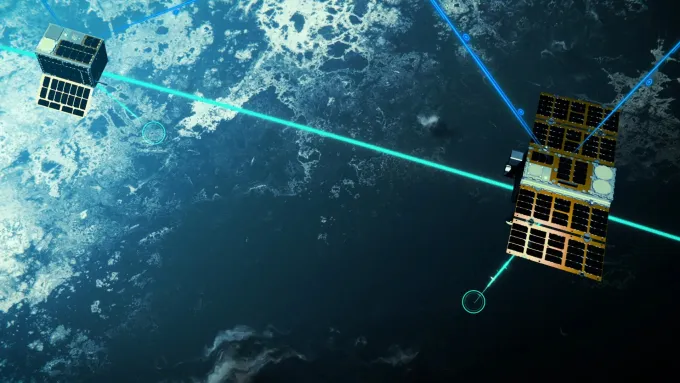
We are proud to announce that our ALL-BANDS GNSS ANTENNA has successfully completed its qualification campaign and is now qualified for space applications.
This achievement confirms that the antenna has demonstrated the performance, robustness, and reliability required to operate in the demanding conditions of space. From design and manufacturing to testing and validation, every step has contributed to reaching this important milestone.
Reaching space starts long before launch.
Before a component can become part of a satellite, it must prove that it can perform flawlessly in one of the harshest environments imaginable. For our GNSS ANTENNA, that journey has now reached an important milestone: it has successfully completed its qualification campaign and is officially qualified for space applications.
This result is the culmination of months of engineering, manufacturing, testing and validation, with every phase designed to answer one fundamental question:
Is the antenna ready for space?
The Qualification Journey
Step 1 – Proving RF Performance
Every qualification campaign begins by validating what matters most: performance.
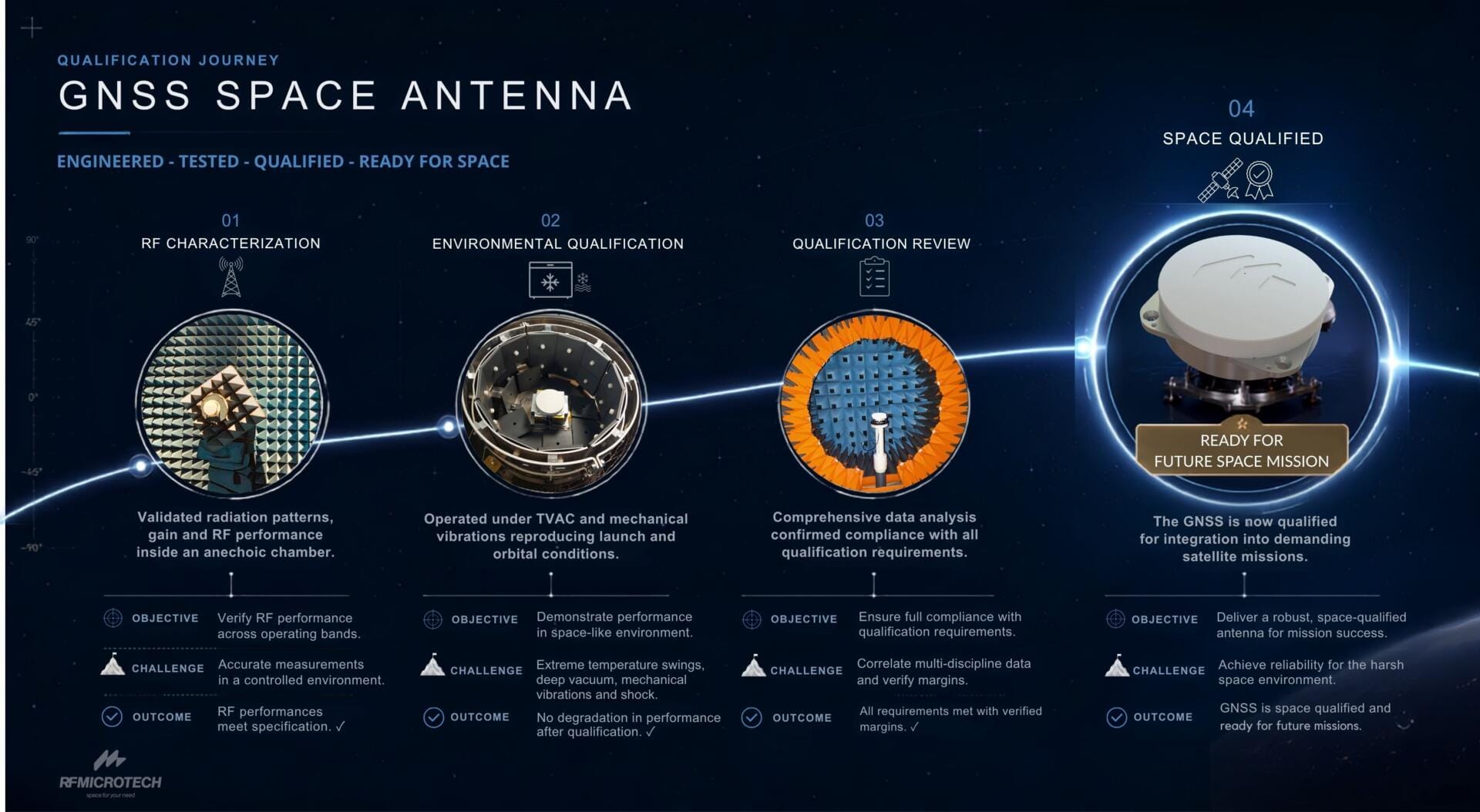
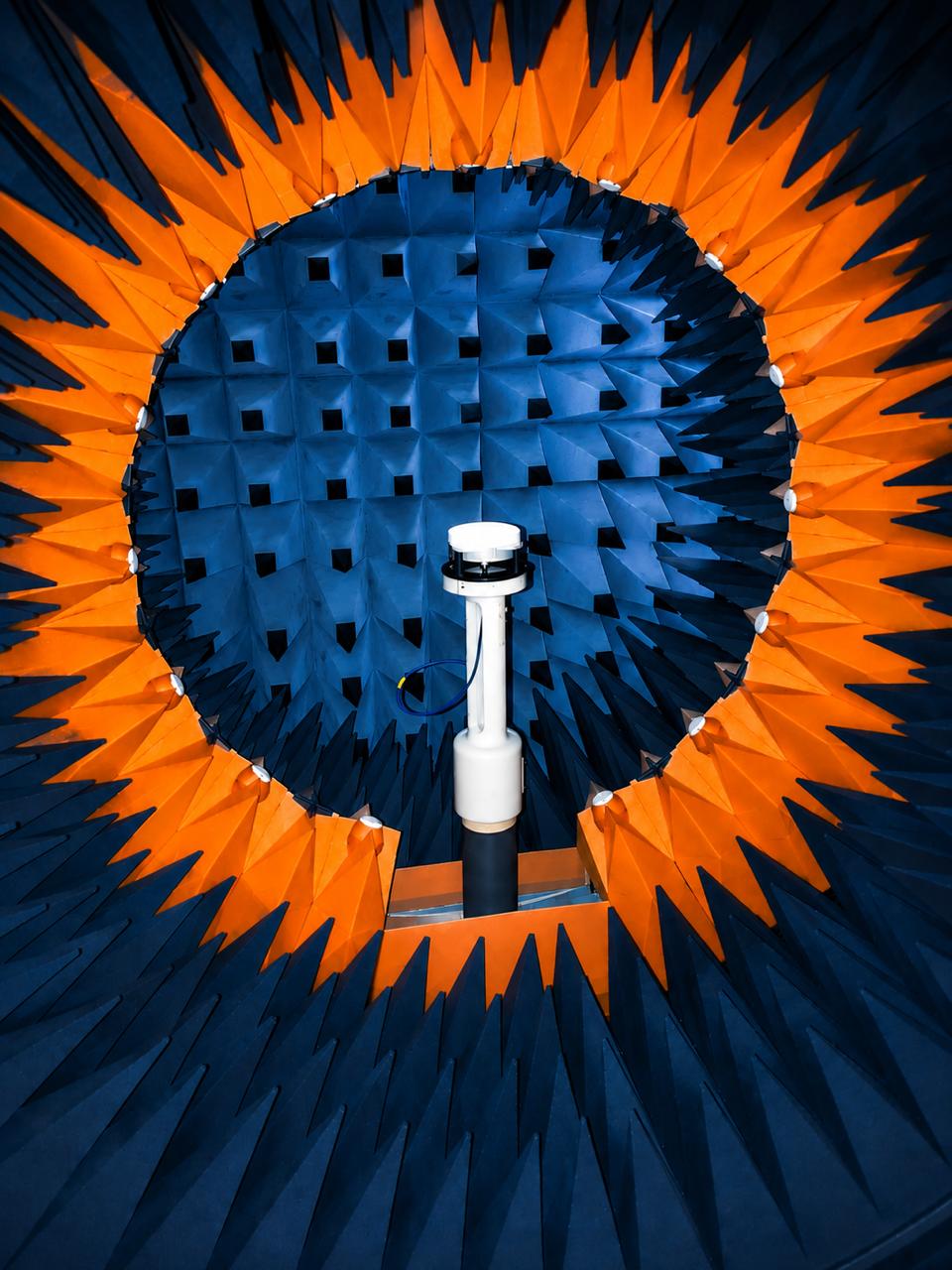
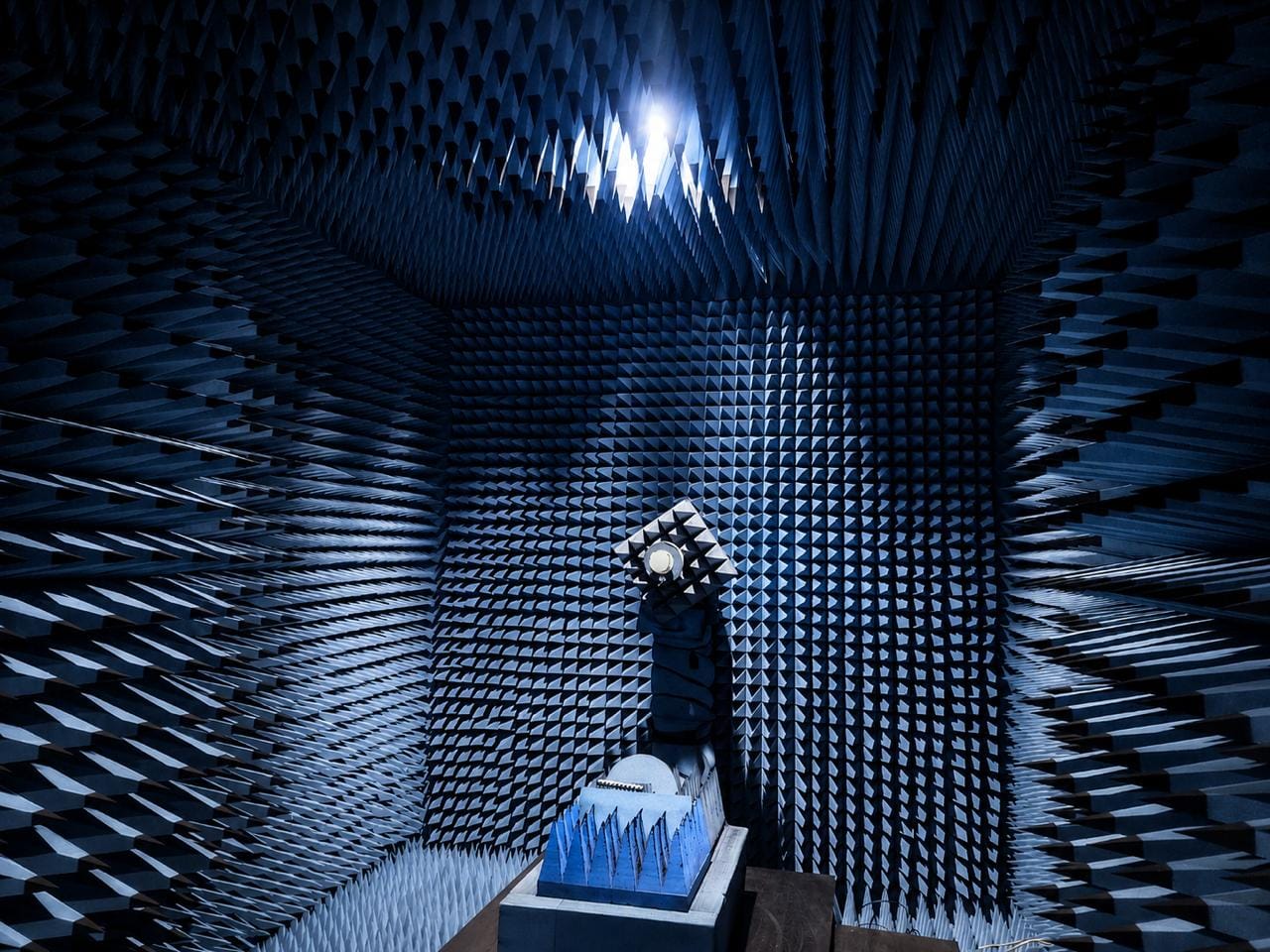
Inside a fully controlled anechoic chamber, the antenna underwent an extensive RF characterization campaign. Free from external interference, the team measured radiation patterns, gain and other critical antenna parameters to verify that the design delivered the expected performance.
This first step confirmed that the antenna met the demanding RF requirements needed for precise GNSS operation.
- HIGH GAIN:
- GAIN IN BANDA L1/E1: > 4.7 dB
- GAIN IN BANDA L2: > 4.9 dB
- GAIN IN BAND E6: > 4.1 dB
- GAND IN BANDA L5/E5: > 4.9 dB
- CIRCULAR POLARIZATION: RHCP
- AXIAL RATIO: <3,5 dB on hemisphere
- AXIAL RATIO: <3,5 dB on hemisphere
- WIDE BANDWIDTH: all GPS and Galileo frequency bands
- RETURN LOSS: better than 10 dB over GPS and Galileo frequency bands
- RETURN LOSS: better than 10 dB over GPS and Galileo frequency bands
- HIGH PRECISION
Step 2 – Recreating the Launch Conditions
Reaching orbit means surviving launch.
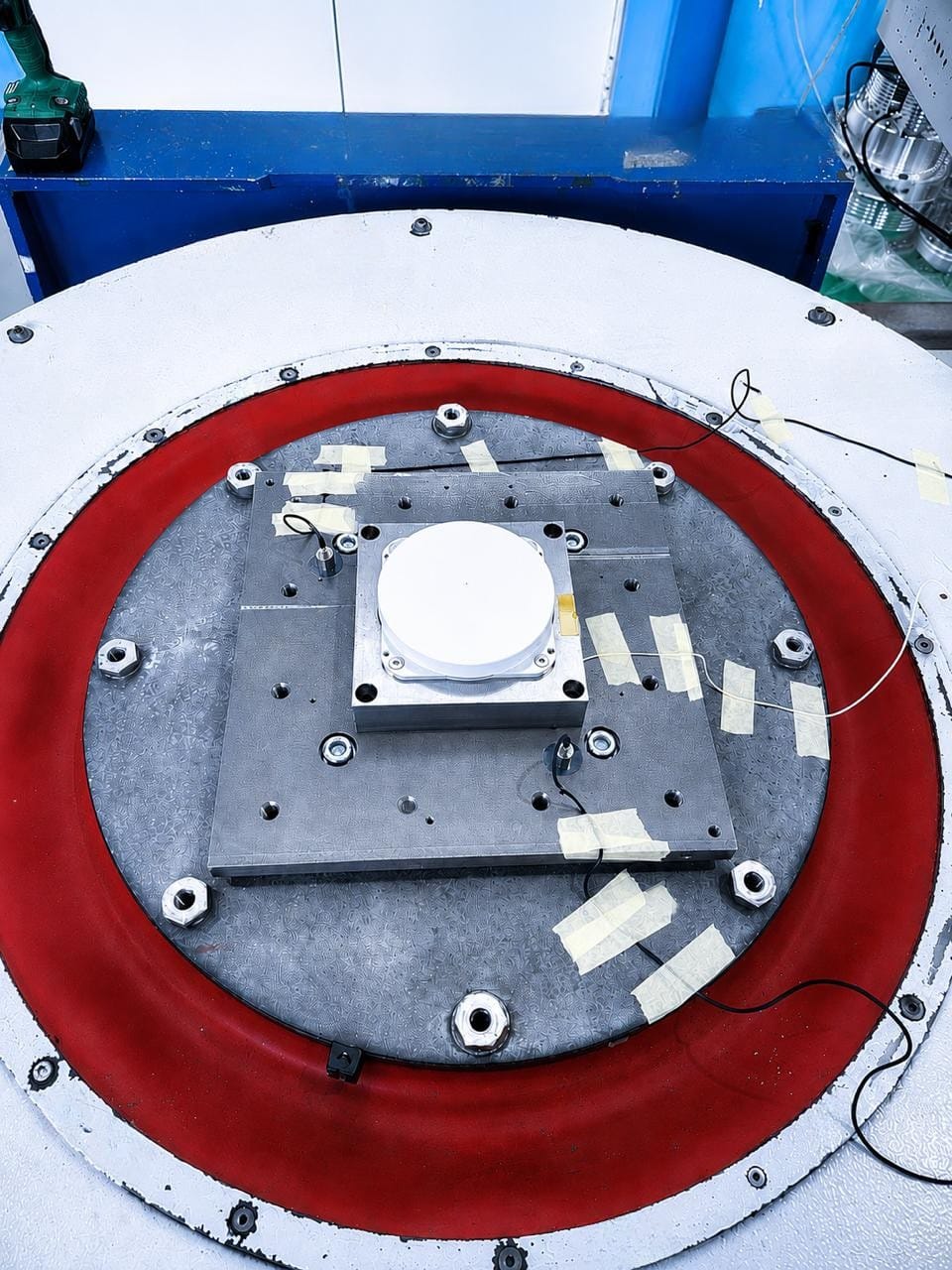
To verify its mechanical robustness, the GNSS Antenna Qualification Model (QM) underwent a comprehensive environmental test campaign, including quasi-static, sinusoidal vibration, random vibration and shock testing. These tests reproduced the intense mechanical loads and vibrations experienced during lift-off.
The successful completion of the campaign confirmed that the antenna can withstand launch conditions while maintaining its structural integrity and operational performance.
Step 3 – Recreating Space on Earth
Outstanding RF performance alone is not enough.
To be qualified for space, the antenna shall operate even when exposed to the extreme conditions it will encounter in orbit.
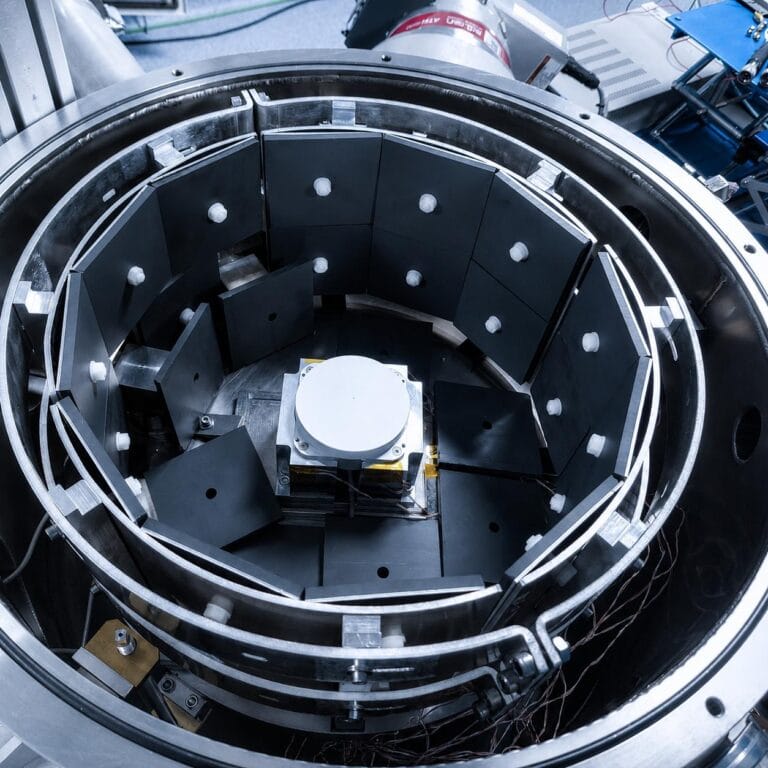
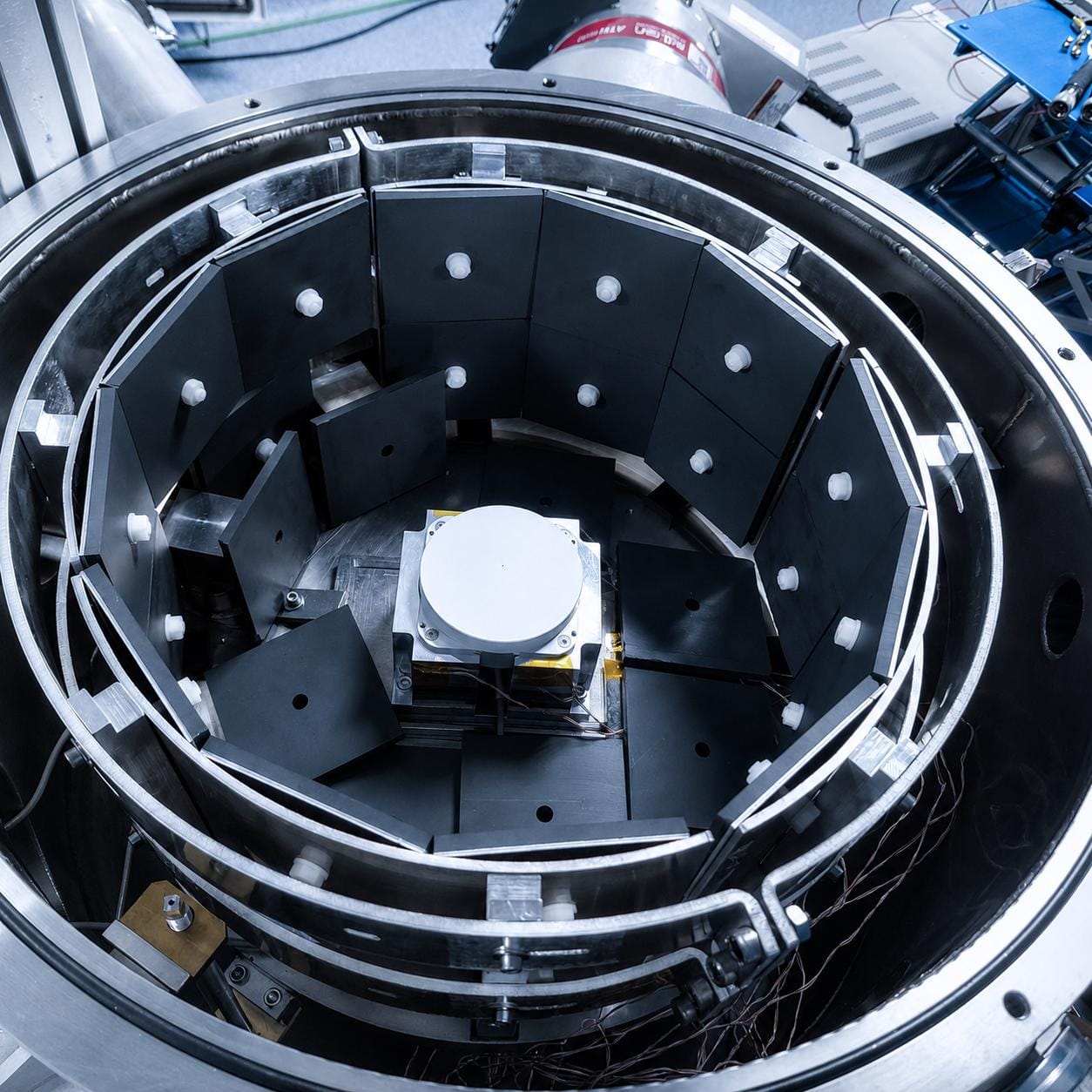
The Qualification Model (QM) was therefore subjected to an Operational Thermal Vacuum (TVAC) campaign. Inside the chamber, the team recreated the space environment by combining deep vacuum with repeated hot and cold temperature cycles.
Throughout the entire campaign, the antenna remained fully operational, demonstrating stable performance under conditions representative of a real mission.
Step 4 – Demonstrating Mission Readiness
Qualification is achieved only when every result comes together.
Following the successful completion of the test campaign and the analysis of all collected data, the A1530A demonstrated the robustness, reliability and performance required for space applications.
This final assessment confirms that the antenna is ready to support future satellite missions where reliability is essential and maintenance is simply not an option.
Qualified, Production-Ready and Available as a Catalog Product

Successfully completing the qualification campaign means far more than passing a series of laboratory tests.
It demonstrates that the antenna can consistently deliver reliable GNSS performance under representative space conditions, providing confidence for system integrators and mission designers alike.
Today, the antenna stands ready for integration into future space missions, supporting advanced positioning and navigation applications where performance must remain uncompromised throughout the mission lifetime. With qualification successfully completed, the GNSS antenna is now ready for serial production and available as a standard catalogue product, enabling customers to rapidly integrate a flight-qualified GNSS antenna into their space programs.

Download the All-bands GNSS Antenna datasheet to explore its full technical specifications!
https://rfmicrotech.com/antennas/all-band-high-gain-gnss-antenna
Explore the Qualification Journey
A selection of images captures the key stages of the qualification campaign.

REQUEST A QUOTE https://rfmicrotech.com/antennas/all-band-high-gain-gnss-antenna/