HoRuS – HPC for RF subsystems
 FFplus – FortissimoPlus project for the integration of High-Performance Computing (HPC) in the design and manufacturing of Radio Frequency (RF) filters and antennas.
More info about the project:
PR Business Experiments website
CONTEXT
Wideband Radio Frequency (RF) Devices for space applications require demanding and time-consuming RF simulations through the Finite-Difference Time-Domain (FDTD) method and Thermomechanical topology optimization.
Standard methods with limited computational power set a constrain to the mesh accuracy, besides a long design phase. Thermomechanical design is generally handled separately from the RF design. Additional prototyping is necessary to guarantee performance during a product development, further increasing development time and costs.
OBJECTIVES
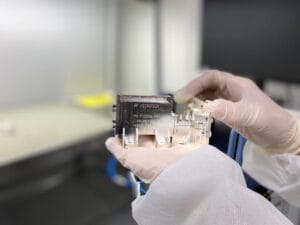 HoRuS – HPC for RF Subsystems experiment focuses on leveraging High Performance Computing (HPC) to optimize Radio Frequency (RF) subsystems. The goal is to improve the performance and efficiency of RF devices through advanced simulations and predictive modelling, utilizing high computing power.
In this experiment, applications involve the design, fabrication and testing of complex RF components used in telecommunications, radar, and space communication systems. By adapting a Multiphysics simulator used in the design phase for compatibility with HPC, the time required for the development and optimization of these systems is significantly reduced, improving both accuracy and speed in design processes.
This HoRuS project aims at the experimental verification of the benefits of HPC in streamlining the conception and development of RF filters and antennas.
RESULTS
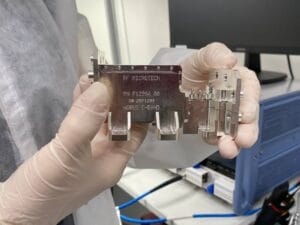 The HoRuS experiment developed an HPC-based simulation workflow to improve the design of RF filters, antennas and subsystems for space applications. The solution combined Open Engineering’s simulation platform with two complementary tools: OOFELIE for thermomechanical optimisation and cuFDTD for electromagnetic analysis. Both software environments were adapted to run on the Leonardo HPC infrastructure, including the development of a new multi-GPU version of the electromagnetic solver.
Using HPC made it possible to distribute simulations across up to four GPUs within a compute node, overcoming memory limitations of standard workstations and enabling much larger and more detailed models to be analysed. The output of the experiment was a scalable digital design workflow capable of running high-fidelity multiphysics simulations in half the previous time, supporting faster optimisation, better engineering decisions, and future development of more complex RF products.
Business Benefits
- 2x faster simulations compared with previous single-GPU workflows, significantly reducing engineering turnaround time.
- Up to 4 GPUs used simultaneously on HPC infrastructure, enabling analysis of RF models previously exceeding workstation memory limits.
- 50% reduction in design time for new space RF filters requiring both electromagnetic and thermomechanical optimization.
- 50% reduction in engineering design costs for low-volume, high-value aerospace developments.
- 25% reduction in overall product cost, translating into an estimated 25% margin increase for RF Microtech.
- New multi-GPU simulation capability developed by Open Engineering, enabling scalable future HPC-based engineering services.
STATUS
Completed
PARTNERS
 | RF MICROTECH SRL – Prime https://rfmicrotech.com |
 | OPEN ENGINEERING SA https://www.open-engineering.com |